
Safe Travel – Guide Dog Refusals & Supported Transport
Guide dog refusals in Australia remain far too common. The penalties for refusing access are substantial, yet Uber and taxi drivers continue to drive past people who are blind or have low vision—sometimes slowing down, seeing the guide dog or white cane, and then simply moving on.
Many of us track our vehicle in real time through the Uber app. We know when a driver sees us, and we certainly know when they leave us behind. This behaviour has been systemic for years, and it is getting worse.
Australia welcomes people from many cultures, and our transport industry relies heavily on new arrivals whose qualifications may not be formally recognised here. But if someone comes from a culture where dogs are feared, unfamiliar, or considered unclean, then front-line passenger transport may not be the right profession.
Refusing a guide dog is unlawful, unsafe, and deeply discriminatory.
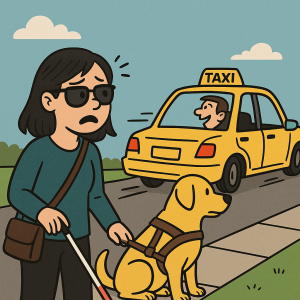
Since recording this video, a friend and I have begun using the term Supported Transport to describe something many of us rely on every day.
Services such as Blue Diamond Transfers consistently demonstrate what safe, respectful, and inclusive transport looks like:
- assisting a blind traveller through airport terminals
- helping with check-in or baggage collection
- guiding us to the correct entrance of unfamiliar buildings
- ensuring safe road crossings and safe arrival at venues
- supporting people during rehearsals, performances, medical appointments, or any location where navigation is complex
When a driver steps out of the vehicle to ensure we reach the right place safely, they are not simply transporting us—they are providing Supported Transport.
And Importantly:
It is cheaper for the NDIS to fund this model than a support worker.
We have already run the figures. Supported Transport delivers safety, efficiency, dignity, and value for money.
A number of new examples involving Blue Diamond have emerged since the original recording of this video, so I will be re-recording an updated version soon. For now, the message is simple:
We ask that the NDIS needs to recognise Supported Transport and fund it accordingly—just as they would fund a support worker performing the same task.