The post Troubleshooting and Technical Remediation appeared first on Disability & Assistive Technology Access Australasia.
]]>Orientation and Mobility Instructors and Occupational Therapists do vital work, but access technology is a specialist field in its own right. When things go wrong—and they often do—it requires the knowledge of someone who is not only a trainer, but also a qualified technician.
As an experienced access technology trainer and trained technician, I understand that troubleshooting (also known as technical remediation) is just as critical as the training itself for people who are blind or have low vision. Access technology is complex. Multiple layers of software and hardware interact, and resolving issues can take hours of methodical diagnosis, repair, and sometimes complete reinstallation.
This can involve reinstalling specialist software such as ZoomText, JAWS, and ZoomText Fusion, resolving issues with NVDA (the free screen reader), or addressing problems caused by failed updates, User Account Control settings in Microsoft Windows, or audio and display conflicts. Similar challenges can also arise on Apple devices, including Macs and iPhones. These are not issues that can be resolved without deep technical understanding.
In this video, I walk through four recent real-world troubleshooting cases:
Case One:
A person with low vision experienced a blank screen while transitioning to JAWS as their eyesight declined. They still occasionally rely on visual information, and the display unexpectedly went blank when the device was connected to power.
Cases Two and Three:
In two similar cases, learners attempted minor updates to JAWS and ZoomText Fusion between sessions. The updates failed, resulting in systems that were unusable. Resolution required several hours of work, including removing corrupted JAWS components and outdated software such as OmniPage OCR. In one case, I was able to stabilise access overnight by remotely reverting to a sandboxed installation of JAWS 2024 to get the client through the night until I was able to see them. This did not interfere with the 2025 version.
Case Four:
A totally blind user experienced complete loss of audio—just as critical as a blank screen is for a low-vision user. The issue was traced to special function keys and a disabled audio device, potentially at the BIOS level. This case provided a clear example of how access technology spans multiple layers: BIOS, operating system, and application software.
These examples clearly demonstrate why access technology should not be “lumped in” with other blindness disciplines.
Orientation and mobility and occupational therapy are essential disciplines—but access technology requires dedicated training, technical expertise, and real-world troubleshooting experience.
This video offers insight into the often unseen technical work that underpins successful access technology use—and why specialist knowledge truly matters.
– #AccessTechnology
– #AssistiveTechnology
– #BlindAndLowVision
– #DigitalAccessibility
– #AccessTechnologyTraining
– #AccessTechnologySpecialist
– #TechnicalRemediation
– #JAWS
– #ZoomText
– #NVDA
– #AppleAccessibility
– #WindowsAccessibility
– #InclusiveTechnology
– #DisabilitySupport
– #NDIS
– #ProfessionalStandards
– #RightSkillsForTheRole
The post Troubleshooting and Technical Remediation appeared first on Disability & Assistive Technology Access Australasia.
]]>The post Podcast Appearance: Elise Lonsdale on the Aaron’s Opinion Podcast – With Aaron Richmond appeared first on Disability & Assistive Technology Access Australasia.
]]>My Journey
In this wide-ranging conversation, I reflect on humble beginnings — factory work, manual labour, and wiring neon signs — through to advanced IT and Access Technology training. We talk about my earlier roles as a helpdesk analyst, web developer, DAISY talking book producer, and how those experiences shaped my work as an Access Technology trainer.
Communication, Leadership, and Community
I discuss the role Toastmasters has played in helping me structure my thinking, refine my communication, and become a more effective trainer and presenter. This journey naturally led to my involvement with the Apple User Society of Melbourne, including time as Vice President, and later to my work with the Statewide Vision Resource Centre (SVRC).
DATA Australasia and Training Philosophy
We explore how DATA Australasia was formed, why the name was chosen, and why curriculum-based training in Access Technology matters. I strongly advocate for foundational skills — such as keyboarding and touch-screen gestures — being taught before higher-level tasks like social media, word processing, email and advanced applications. Without strong foundational skills in access technology, learners are being set up to struggle by some of our Major blindness organisations.
Sector Experience and Independence
The podcast also touches on my experiences working across Australia and New Zealand, including roles with Vision Australia, the Blind Foundation in New Zealand, and Visibility in Western Australia. I explain why moving away from large organisations allowed me to work more independently and deliver better outcomes for learners.
Blindness and Beyond Referral Network
In the same year I founded DATA Australasia, I also helped establish the Blindness and Beyond Referral Network. This network connects people with Orientation and Mobility instructors, orthoptists, occupational therapists, Access Technology specialists, and support workers — supporting genuine choice and control within the NDIS.
Training, Policy, and the NDIS
We discuss my study toward the Certificate IV in Training and Assessment and how it strengthens my ability to deliver specialised training. I also reflect on the National Disability Insurance Scheme (NDIS), how it once enabled innovation and specialised training, and how recent policy changes have undermined those opportunities.
Education and Literacy
I share my concern about outdated “sight-first” policies that still exist in some education settings, denying some children early access to braille during formative years of language development.
Closing Thoughts
Despite the challenges, I remain deeply positive about my work. I genuinely love what I do and do what I love. I enjoy creating YouTube content, networking, promoting good work, and connecting people — always for the greater good.
Thank you to Aaron Richmond for the opportunity to share this conversation.
The post Podcast Appearance: Elise Lonsdale on the Aaron’s Opinion Podcast – With Aaron Richmond appeared first on Disability & Assistive Technology Access Australasia.
]]>The post 🎄 Merry Christmas & Thank You 🎄 appeared first on Disability & Assistive Technology Access Australasia.
]]>A big thank you to Gikken, my taxi driver, and to his fellow Silver Service taxi drivers. Reliable transport is essential to my work, and your professionalism genuinely makes my job possible.
Thank you to my sister, Kasey for her ongoing moral support and for allowing me to work from her place when needed.
To my friend Kellie, thank you for being my business coach and for your guidance and encouragement.
To Kylie, the voice of DATA Australasia — thank you for your announcements, communications support, and help with report writing.
To my dear friend Kirsten, thank you for your support during my studies. I truly don’t think I would have made it through that course without you.
Thank you to my bookkeepers, Miquette and Marnie, for managing QuickBooks and supporting the transition to Xero, and to my accountant Michael for his steady and reliable advice.
And finally, to my dear friend Annette — you came into my life as an NDIS support worker but have become so much more. Your friendship and support, especially during my recent pre-cancer diagnosis, have meant the world to me.
I also want to sincerely thank all my clients and everyone involved with my work, particularly through DATA Australasia. Your trust and support mean everything.
I’m looking forward to rebuilding and growing the business further in 2026.
Thank you all for being part of this journey and Merry Christmas and happy 2026.
The post 🎄 Merry Christmas & Thank You 🎄 appeared first on Disability & Assistive Technology Access Australasia.
]]>The post DATA Australasia & Statewide Vision Resource Centre (SVRC) appeared first on Disability & Assistive Technology Access Australasia.
]]>In this video, I reflect on the symbiotic relationship between DATA Australasia and my ongoing role with the Statewide Vision Resource Centre (SVRC) as part of the Support Skills Program.
Shortly after founding DATA Australasia in 2019, I was invited to contribute my access technology expertise to the Support Skills Program. This involved translating skills traditionally delivered to adults into learning contexts for children. More than six years later, I remain a permanent member of the SVRC team, working in a highly specialised role that I continue to value greatly.
Interestingly, this opportunity did not emerge directly through the blindness sector, but via the Apple Users Society of Melbourne. What began as a simple networking connection became a professionally significant relationship. In 2019, the NDIS provided fertile ground for building a small specialist business; while the landscape has since changed, the value of strong professional networks has only increased.
There are three aspects of this dual role that I particularly appreciate.
First, the knowledge transfer is constant and reciprocal. Insights gained through my work at SVRC directly inform my private practice, while innovations and strategies developed through DATA Australasia strengthen my contribution to the Support Skills Program.
Second, the role provides rich professional connection. I work alongside parents, teachers, itinerant teachers, and allied professionals, building relationships that strengthen outcomes across both settings.
Importantly, there is no conflict of interest. The Support Skills Program delivers a breadth of services well beyond the scope of a small private practice, including access technology, daily living skills, orientation and mobility, and curriculum-linked areas such as mathematics, music, physical education, and sport. This breadth makes it an invaluable learning environment for students and a continual professional learning opportunity for me.
The third aspect is the opportunity for targeted project work. I am currently planning a second year of professional development in JAWS for Windows, NVDA, and Apple VoiceOver for itinerant teachers in 2026, building on the strong outcomes and practical learning from 2025.
Ultimately, the work I do across both roles is deeply interconnected. Each informs, strengthens, and enriches the other, creating a genuinely mutually beneficial professional relationship.
The post DATA Australasia & Statewide Vision Resource Centre (SVRC) appeared first on Disability & Assistive Technology Access Australasia.
]]>The post Giving Back – Being a Provider on the NDIS as well as Being a participant appeared first on Disability & Assistive Technology Access Australasia.
]]>About ten years ago, while living in New Zealand, I watched the NDIS slowly roll out across Australia and began thinking seriously about coming home. Before returning in 2017, I made a conscious decision: if I was going to engage with the NDIS, I wanted to do so in two ways.
First, as a participant. I truly believed the NDIS would improve my quality of life — and looking back, it absolutely has.
Second, I wanted to give back as a provider. By then, I already had strong access technology skills and years of experience working with people who are blind or have low vision, including training in JAWS, NVDA, Apple VoiceOver, screen magnification, and low-vision solutions.
When my contract work ended, I chose to keep doing what I love. That’s when I started my own business, working directly with people in their homes, in small groups, and online — delivering practical, respectful access technology training that genuinely builds confidence and independence.
Giving back isn’t an add-on for me. It’s the reason I do this work — and I’m proud that journey continues.
If this resonates with you, or if you’re looking for practical access technology training for yourself or someone you support, feel free to reach out or follow my page to stay connected.
The post Giving Back – Being a Provider on the NDIS as well as Being a participant appeared first on Disability & Assistive Technology Access Australasia.
]]>The post The Four Training Disciplines of Blindom — Clarifying Roles for Better Outcomes appeared first on Disability & Assistive Technology Access Australasia.
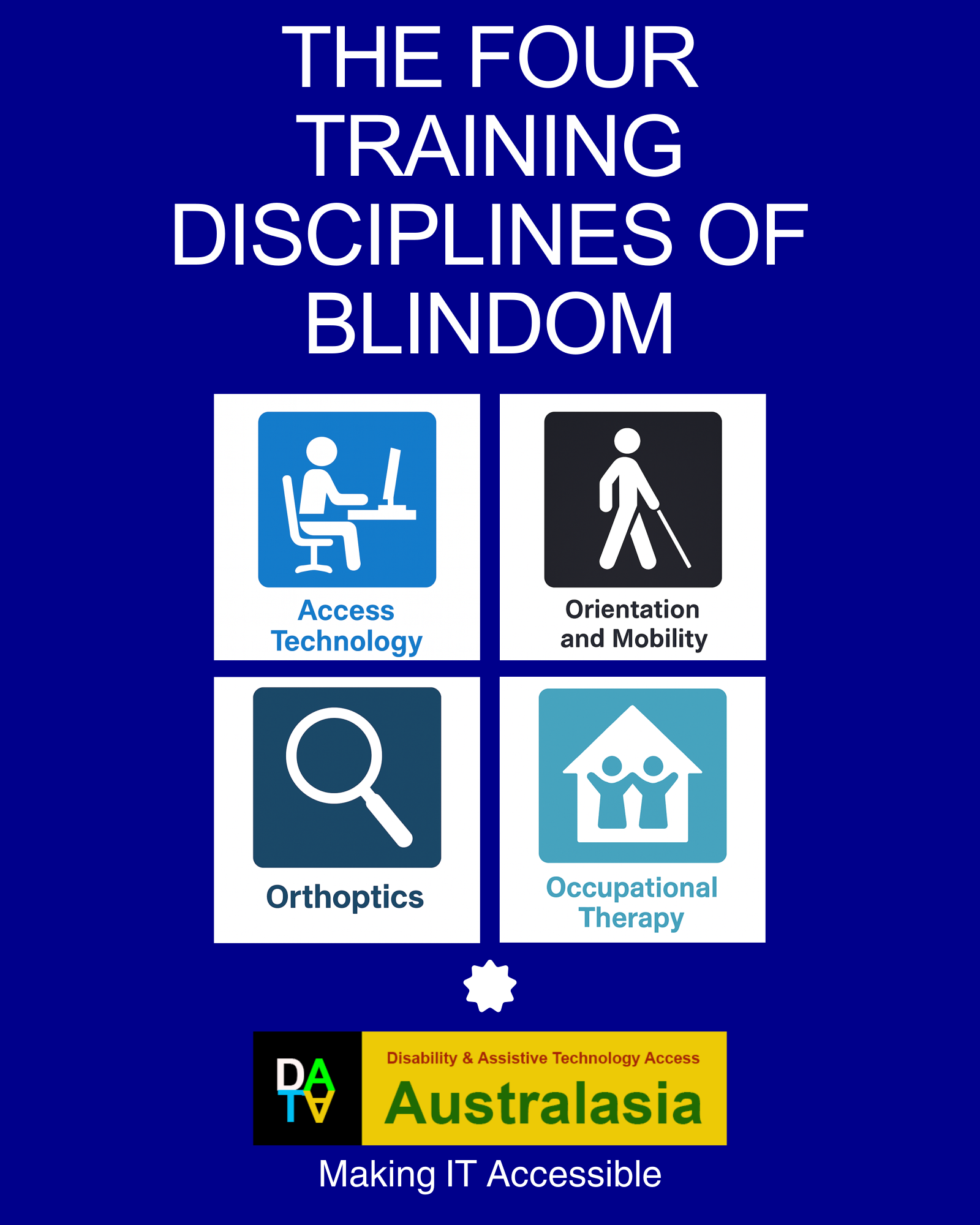
]]>In blindness services, there are four core training disciplines that support a person’s independence:
- Occupational Therapy
- Orientation & Mobility
- Orthoptics / Low Vision
- Access Technolo
While OTs, O&Ms and Orthoptists can introduce simple concepts, expecting them to deliver specialist access technology training isn’t appropriate — and it’s not what most of them want to do. Their disciplines already carry deep and important responsibilities of their own.
The real strength comes from collaboration, not role-blurring.
Clients benefit most when each professional delivers what they do best, and when Access Technology Specialists are supported to provide the depth of training required for meaningful, sustainable independence.
Each field brings genuine expertise. But it’s equally important to recognise where the boundaries are — especially when it comes to Access Technology.
Access Technology requires specialist capability:
- Advanced knowledge of JAWS, NVDA, VoiceOver, TalkBack and magnification tools.
- Understanding of keystrokes, gestures, adaptive workflows and task analysis.
- Technical troubleshooting skills across computers, mobile devices and assistive software.
- The ability to train at foundational, intermediate and advanced levels.
While OTs, O&Ms and Orthoptists can introduce simple concepts, expecting them to deliver specialist access technology training isn’t appropriate — and it’s not what most of them want to do. Their disciplines already carry deep and important responsibilities of their own.
The real strength comes from collaboration, not role-blurring.
Clients benefit most when each professional delivers what they do best, and when Access Technology Specialists are supported to provide the depth of training required for meaningful, sustainable independence.
Clear roles create better outcomes.
Specialisation creates better training.
Collaboration creates a better system.
The post The Four Training Disciplines of Blindom — Clarifying Roles for Better Outcomes appeared first on Disability & Assistive Technology Access Australasia.
]]>The post Formative and Summative Assessment appeared first on Disability & Assistive Technology Access Australasia.
]]>I believe what I do is training, not therapy. Therefore, I discuss the difference between formative and summative assessments. I’ll use my knowledge gained from the Cert IV in Training and Assessment, TAE40122 course to outline these differences, giving people a better understanding of my work.
During my time with learners who are blind or have low vision, I’m constantly assessing whether we can tailor the training to better suit their needs and identify any gaps. This is a formative assessment. If I want to deem them competent before moving on to something else, I use a summative assessment.
Formative Assessment
Formative assessment is ongoing checking of learning while it is still happening. It is low-stakes, flexible, and designed to give feedback — not grades — so learners and trainers can adjust before the end of a unit or course.
Examples include quizzes, practice tasks, observation, questioning, drafts, or skills demonstrations. Its goal is to support improvement and guide learning, not to judge final competence.
Summative Assessment
Summative assessment happens at the end of learning to measure whether the learner has achieved the required standard or competency. It is high-stakes and used to make a final decision, such as passing a unit, awarding a qualification, or certifying competence.
Examples include final projects, practical assessments, exams, or workplace observation checks. Its goal is to evaluate outcomes and make a judgement — not provide ongoing feedback.
Summory
- Formative assessment is for learning.
- Summative assessment is of learning.
#FormativeAssessment #SummativeAssessment #TrainingAndAssessment #TAE40122 #AdultEducation #VETSector #AccessTechnology #BlindnessSupport #LowVisionSupport #InclusiveTraining #CompetencyBasedTraining #SkillsDevelopment #AssessmentTools #LearningForAll #TrainerLife #Assessors #DATAAustralasia #AssistiveTechnology #JAWS #NVDA #VoiceOver #ZoomText #InclusiveEducation #EducationForAll
The post Formative and Summative Assessment appeared first on Disability & Assistive Technology Access Australasia.
]]>The post Safe Travel – Guide Dog Refusals & Supported Transport appeared first on Disability & Assistive Technology Access Australasia.
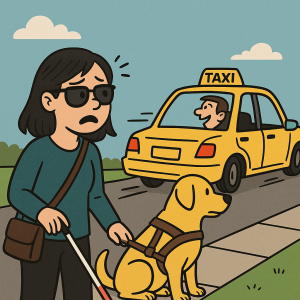
]]>Many of us track our vehicle in real time through the Uber app. We know when a driver sees us, and we certainly know when they leave us behind. This behaviour has been systemic for years, and it is getting worse.
Australia welcomes people from many cultures, and our transport industry relies heavily on new arrivals whose qualifications may not be formally recognised here. But if someone comes from a culture where dogs are feared, unfamiliar, or considered unclean, then front-line passenger transport may not be the right profession.
Refusing a guide dog is unlawful, unsafe, and deeply discriminatory.
Since recording this video, a friend and I have begun using the term Supported Transport to describe something many of us rely on every day.
Services such as Blue Diamond Transfers consistently demonstrate what safe, respectful, and inclusive transport looks like:
- assisting a blind traveller through airport terminals
- helping with check-in or baggage collection
- guiding us to the correct entrance of unfamiliar buildings
- ensuring safe road crossings and safe arrival at venues
- supporting people during rehearsals, performances, medical appointments, or any location where navigation is complex
When a driver steps out of the vehicle to ensure we reach the right place safely, they are not simply transporting us—they are providing Supported Transport.
And Importantly:
It is cheaper for the NDIS to fund this model than a support worker.
We have already run the figures. Supported Transport delivers safety, efficiency, dignity, and value for money.
A number of new examples involving Blue Diamond have emerged since the original recording of this video, so I will be re-recording an updated version soon. For now, the message is simple:
We ask that the NDIS needs to recognise Supported Transport and fund it accordingly—just as they would fund a support worker performing the same task.
The post Safe Travel – Guide Dog Refusals & Supported Transport appeared first on Disability & Assistive Technology Access Australasia.
]]>The post Orientation & Mobility: It’s Training, Not Therapy appeared first on Disability & Assistive Technology Access Australasia.
]]>Orientation and Mobility (O&M) is one of the most important skills a blind or low‑vision person can learn. It’s not therapy in the traditional sense—it’s practical training.
O&M teaches you how to safely move through your environment: getting to work, navigating shops, travelling with a cane or guide dog, understanding tactile ground surface indicators, and building confidence in familiar and new places.
While O&M instructors can use the NDIS therapeutic code for funding, the work itself is hands-on skills training. It’s part of learning how to live independently with blindness or low vision, and it must be delivered by a qualified Orientation & Mobility professional.
It’s all about safety, confidence and knowing how to get where you need to go.
- #OrientationAndMobility
- #LowVision
- #Blind
- #BlindCommunity
- #DisabilityInclusion
- #NDIS
- #IndependentLiving
- #GuideDogHandler
- #AccessibilityMatters
- #CaneSkills
- #InclusiveTravel
- #AssistiveTechnology
- #BlindTraining
- #MobilityTraining
- #OandM
- #SafeTravel
- #VisionAustralia
- #DisabilitySupport
- #BlindnessAwareness
- #DataAustralasia
The post Orientation & Mobility: It’s Training, Not Therapy appeared first on Disability & Assistive Technology Access Australasia.
]]>The post Still Standing – What Doesn’t Kill You Makes you Stronger appeared first on Disability & Assistive Technology Access Australasia.
]]>At the heart of the speech was a line first written by 19th-century philosopher Friedrich Nietzsche:
“What doesn’t kill you makes you stronger.”
It’s a statement that has echoed across generations, and this year, it resonated with me more than ever.
In the speech, I talked openly about the demands of completing my TAE40122 Certificate IV in Training & Assessment, the ongoing cost-of-living crisis, and how it has affected my business with fewer NDIS clients. I spoke about confusion around NDIS billing, the emotional strain of uncertainty, and the feeling of pushing forward even when everything felt uphill.
But I also talked about the bright spots — the moments that reminded me that strength doesn’t only come from hardship; it comes from people.
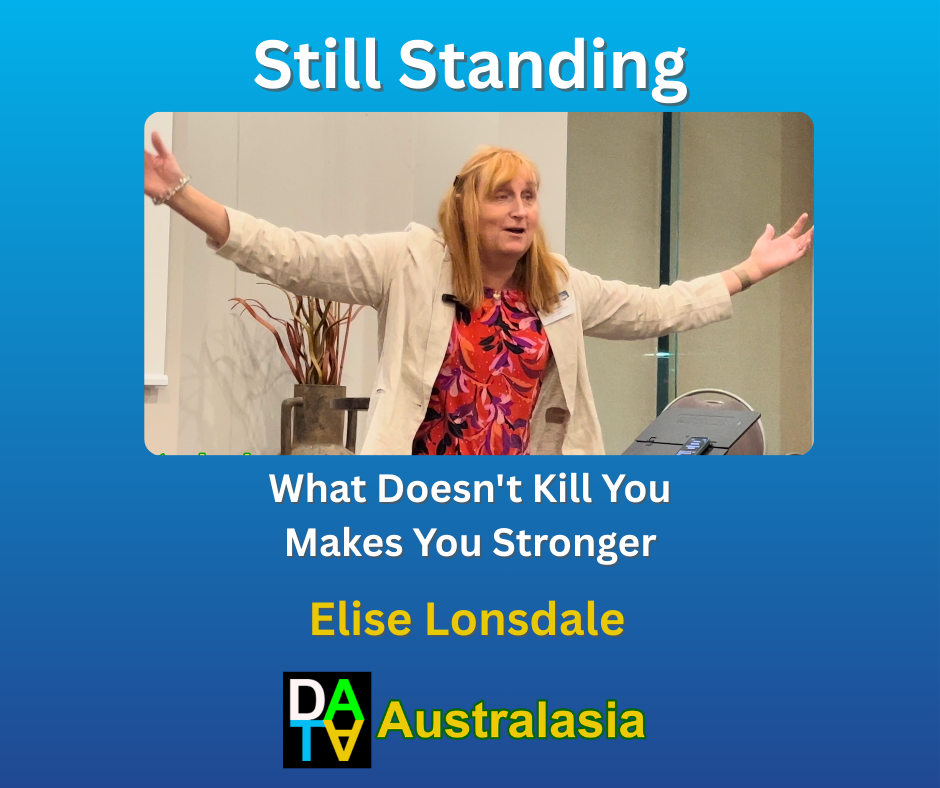
Click the above image to Go straight to the video on YouTube.
- Meeting Kirsten, and the friendship that grew from that connection.
- The joy and privilege of meeting Monique Tonna, Toastmasters Region 12 International Director, just one week earlier at the District 73 Conference.
- The realisation that Kirsten’s suburb in Sydney is near to Parramatta Toastmasters, the club Monique is from — a connection that clicked instantly for me.
- Getting to know Wayne better who reignited my interest in amateur radio, I wish I remembered to put him in the speech, but he was kind enough to film it for me on site at TOCC Toastmasters..
- The relief of having my DCIS pre-cancerous lump removed.
- Celebrating my 60th birthday, despite everything this year has thrown at me.
One of the most difficult chapters was my forced resignation from Croydon Yarra Valley Toastmasters Club — a moment that reduced me to tears as I sent the letter. It felt like a door slamming shut.
What I didn’t yet know, because it happened the day after my speech, is this:
I was reinstated to CYV Toastmasters and as of the time of this writing, looking forward to attending my first meeting back later this week .
A wrong was righted — and that resolution deserves its place in the story.
This Speech is in its rawest form, having only a few hours notice prior to my giving it. It Is my hope that may be a more refined version of this speech might be entered into the International speech contest next year.
After all of it — the setbacks, the challenges, the confusion, the health scares, the emotional toll — I’m still here.
Still working.
Still showing up.
Still serving my community.
Still standing.
If my speech reaches even one person who feels they are carrying too much right now, then sharing it was worth every moment. Resilience isn’t about being untouched — it’s about rising, even if you rise slowly.
Still Standing, resilience, what doesnt kill you makes you stronger, Friedrich Nietzsche, motivational speech, Toastmasters, Toastmasters International, public speaking, District 73, Region 12, personal growth, overcoming adversity, TAE40122, adult education, vocational education, VET sector, access technology, digital accessibility, NDIS community, life journey, DCIS, health journey, 60th birthday, strength through struggle, inspirational story, reflective speech
The post Still Standing – What Doesn’t Kill You Makes you Stronger appeared first on Disability & Assistive Technology Access Australasia.
]]>